What Is Money? The Evolution From Barter to Web3
Money was never a physical object; it is a socio-economic technology built on collective trust. Discover how the shift from gold to fiat currency actually works, uncover inflation's hidden mechanics, and see how Web3 is engineering a new financial future.

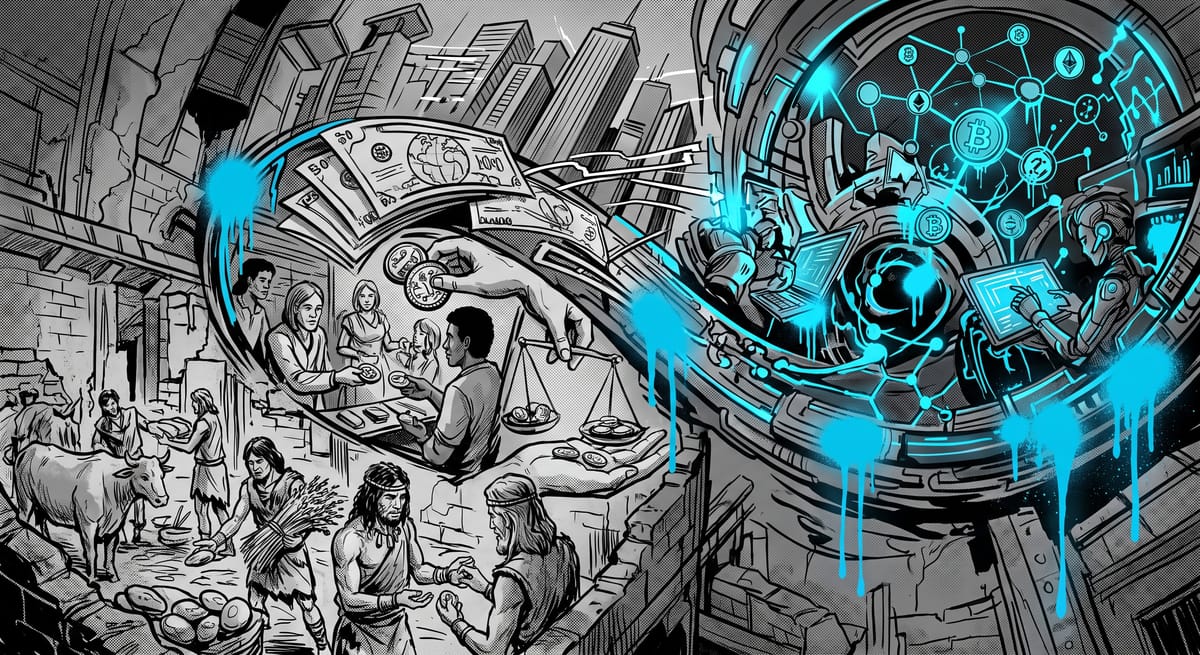
Money is one of the most powerful technologies humanity has ever built. But what we call "money" isn't just the bills in your wallet, the digits in your bank account, or the Bitcoin sitting in your crypto wallet. Money is a massive economic coordination system. It is the mechanism that lets millions of strangers exchange value with each other every single day. So before we can really answer "what is money?", we need to understand why a world without it simply falls apart.
Because money didn't appear overnight on some inventor's drafting table. It evolved slowly as a solution to economic problems that plagued humanity for thousands of years. The rise of Bitcoin and Web3 finance today isn't the closing chapter of that story. It is a brand-new one in which the very design of money is back on the table.
Why Did Money Even Exist?
Picture yourself as a farmer. You've got wheat to spare, but your shoes are falling apart. You walk over to the cobbler and offer him wheat, except he doesn't want wheat; he wants meat. So now you're stuck. First you need to find a butcher who wants your wheat, trade it for meat, and only then can you bring that meat back to the cobbler and finally get your shoes. Economists have a name for this headache: the double coincidence of wants.
It sounds like a minor inconvenience, but scale it up and it becomes a civilization-breaking problem. In a city of thousands, there is no realistic way to track who owns what and what everyone is willing to accept in return. What humanity actually needed wasn't another valuable commodity. It needed a shared language for value itself, and that is exactly the gap money filled.
Gold: The First Great Monetary Technology
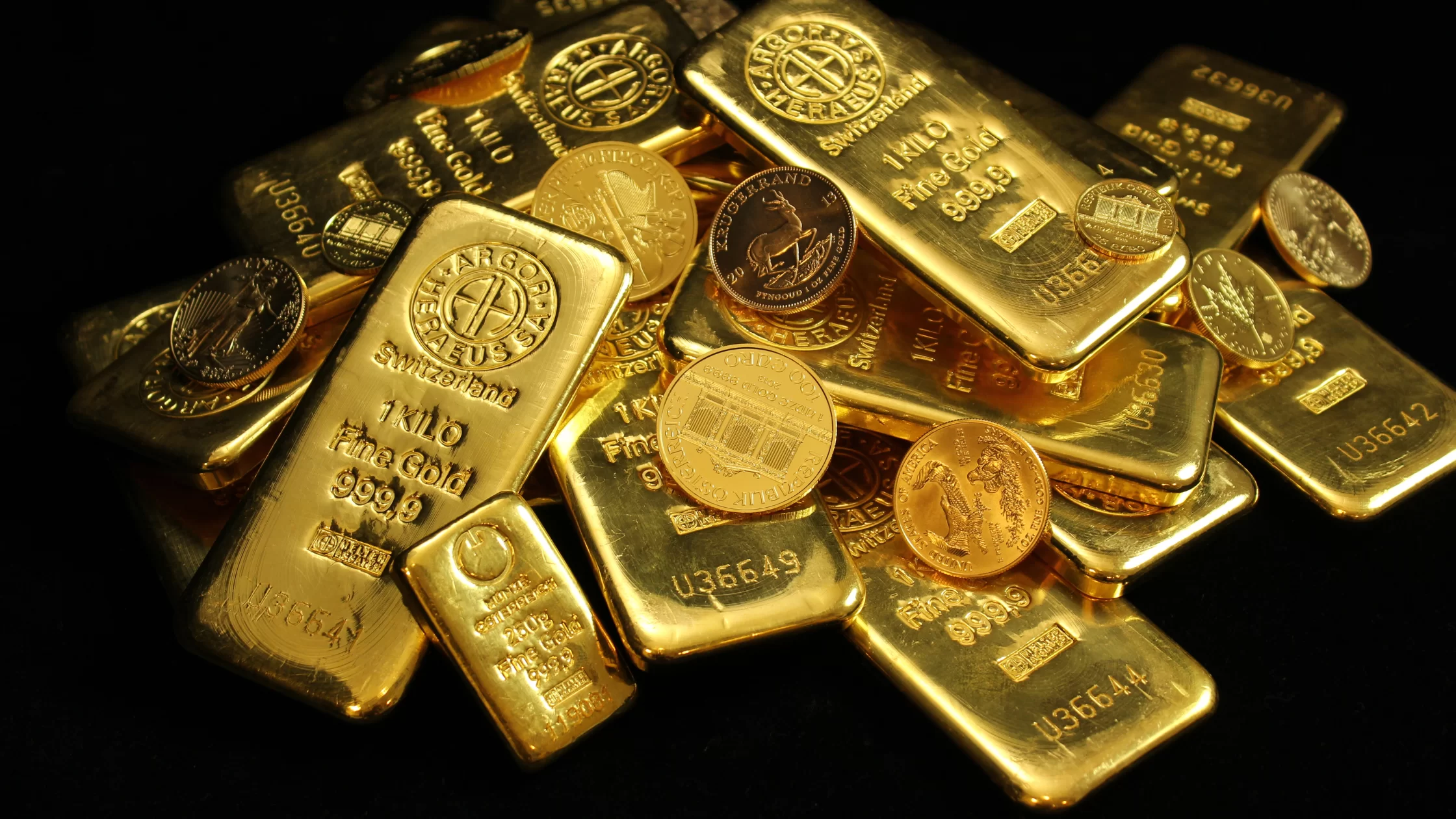
Throughout history, societies have used all sorts of things as money. Gold pulled ahead of the pack because it hit every requirement a good money needs to hit, all at once:
- Divisibility: It could be broken into smaller units.
- Durability: It didn't corrode, rot, or degrade over time.
- Portability: Enormous value could be packed into a tiny amount of physical space.
- Scarcity: Its supply was never unlimited.
- Fungibility: One gram of gold behaved exactly like any other gram of gold.
- Verifiability: Its physical properties made it genuinely hard to fake.
Here is the crucial insight buried in all of this: money, at its core, is a trust technology. Gold let total strangers exchange real value without needing to personally vouch for each other's honesty. All that mattered was that society as a whole agreed the gold was worth something. But gold had one glaring flaw: it was heavy.
From Gold to Paper: Outsourcing Trust
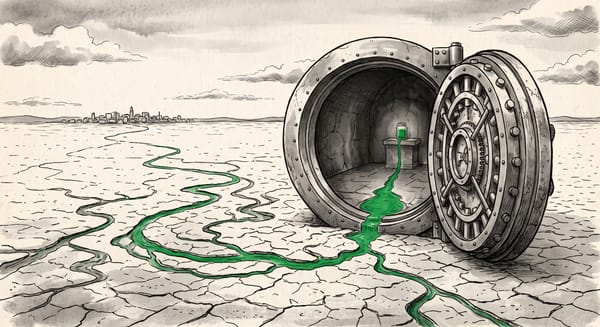
For a merchant hauling goods thousands of miles, lugging bars of gold along was both exhausting and dangerous. The fix over time was to stop carrying the gold itself and start carrying a claim on it instead. People began depositing their gold in trusted vaults and walking away with paper receipts representing that value. Eventually, instead of redeeming the actual gold, people just started handing those receipts directly to one another.
This was a genuinely revolutionary shift in the history of money. People stopped moving value itself and started moving the right to access it. Under the gold standard, the fact that banknotes could still be redeemed for gold kept the entire system honest. But as economies expanded, wars broke out, and government spending climbed, the gold sitting in the vaults could no longer back up all the paper being printed against it.
1971: The Year Money Cut Its Last Tie to Gold
Under the Bretton Woods system set up after World War II, the U.S. dollar was pegged to gold, and virtually every other currency was pegged to the dollar. However, as America's overseas spending grew and dollars flooded global markets, cracks started to show. When countries began lining up to convert their dollar reserves into gold, the whole system hit a breaking point.
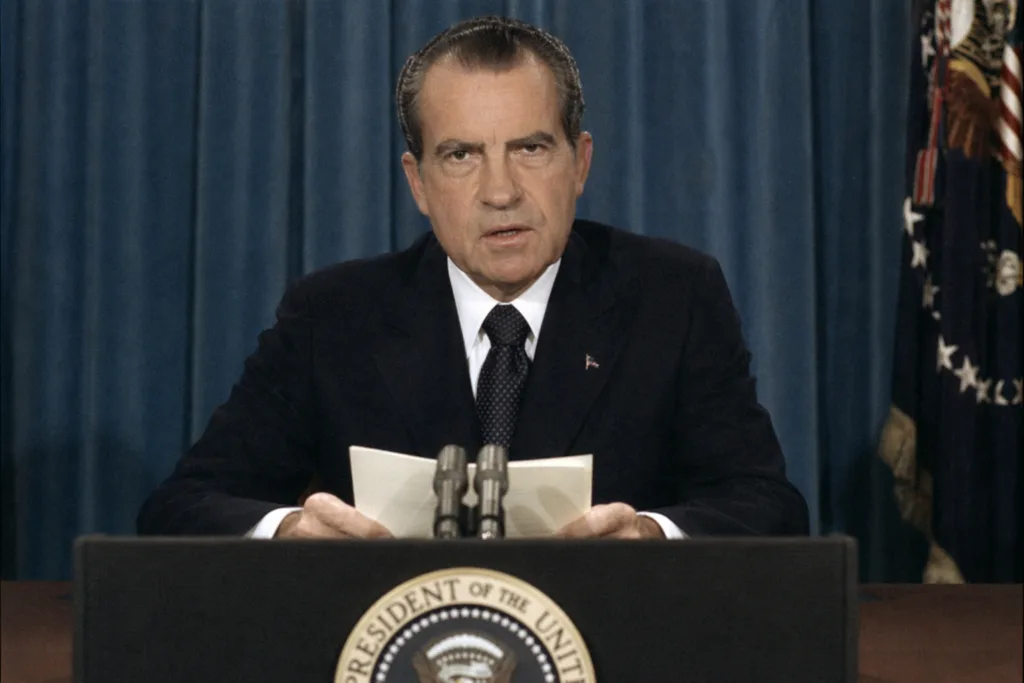
On August 15, 1971, U.S. President Richard Nixon announced that the dollar would no longer be convertible into gold. That moment, now remembered as the "Nixon Shock", severed money's last physical link to gold permanently.
In the modern system, currencies no longer rest on any physical metal at all. This is what we now call fiat currency. Fiat money isn't worthless paper; its value comes from a government's legal authority, its tax system, and the trust society places in it. Unlike under the gold standard, there is no longer any physical ceiling on how much of it can exist. That boundlessness gave birth to the biggest economic problem of the modern era: inflation.
Inflation: The Hidden Tax on Your Time
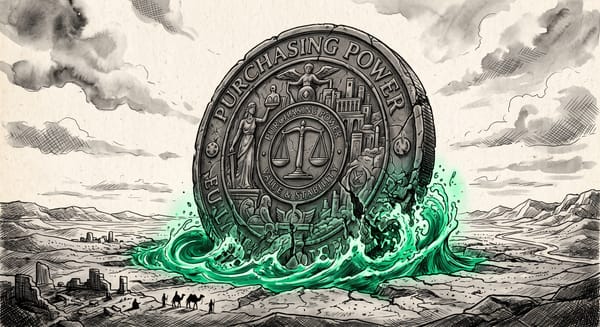
Inflation isn't just prices creeping up at the grocery store. It is your money's purchasing power quietly eroding underneath you. When something that cost 100 units today costs dramatically more a few years from now, that is rarely because the product got more valuable. It is because your money got weaker.
When the money supply and available credit expand faster than actual economic output, prices get pushed upward as a direct consequence. The number in your bank account can stay exactly the same while the purchasing power behind that number keeps shrinking year after year. That is why inflation functions as a hidden tax, one that quietly drains the savings of anyone holding cash or living on a fixed salary. This brings us to history's oldest monetary question: who actually gets to decide the rules of the money supply?
Bitcoin and Algorithmic Scarcity
The Bitcoin whitepaper, published in the shadow of the 2008 global financial crisis, offered a radical answer to that exact question. Bitcoin's core proposition was never to build a new bank. It was to make digital value transfer possible without a bank at all.
Copying a digital file, like a photo, and sending it to two different people at once is trivial. How do you stop someone from spending the same digital coin twice? In the traditional system, a central institution like a bank polices that. Bitcoin solved the identical problem with zero central authority, relying instead on cryptography, a distributed network, and mathematical consensus.
Bitcoin's single greatest revolution in monetary history is that its supply is locked in by code. Total supply is hard-capped at 21 million coins. Gold's scarcity comes from the physical world; Bitcoin's scarcity comes from its protocol, and anyone can verify it transparently. This is known as algorithmic scarcity. No government and no central bank can arbitrarily push past that 21-million ceiling.
The Evolution of Trust: From Institutions to Code
In traditional finance, the record of your account lives inside an institution's private ledger. The bank knows your balance, processes your transfers, and can freeze your account whenever it decides to. Central banks and governments write the rulebook.
On Bitcoin, transactions are verified by a distributed network and recorded transparently on a public blockchain. As long as individuals control their own private keys, they have direct access to their assets with no middleman required. This is described as trustless. That doesn't mean no trust exists at all; it means you are no longer required to trust a central institution just to make a transaction go through. Trust hasn't vanished. It has simply migrated from institutions into math and code.
Web3 Finance and Becoming Your Own Bank
Bitcoin solved the problem of money itself, and Web3 is now stretching that same logic across the entire financial system. At its center are smart contracts: code that executes transactions automatically once certain conditions are met, effectively turning finance into software. Through decentralized finance (DeFi), users can operate with no middleman in sight to:
- Swap assets directly
- Provide liquidity
- Borrow and lend
- Use their own digital assets as collateral
The "be your own bank" promise at the heart of Web3 is a genuine technical revolution, but it comes bundled with real responsibility. Lose your private key, and there is no customer service line waiting to help you. Decentralization isn't just freedom; it is an entirely new model of security, and the weight of that security now rests on you.
Conclusion: The Future of Money Is Being Rewritten
Money was never just paper, metal, or a number glowing on a screen. The road from barter to gold, from gold to paper, and from fiat currency to blockchain-based digital assets is really one long story about a single question: how do we store value, how do we move it, and who do we trust to make that possible?
The real question today has nothing to do with what Bitcoin's price will be next year. It is this: in the digital era, whose rules will money actually run on? Will those rules keep getting written behind the closed doors of central banks, or will they be shaped instead by open protocols, cryptography, and algorithmic scarcity?
Web3 and cryptocurrency aren't just theorizing about an alternative anymore. Through fully functioning global networks, they are proving in real time that the financial system can be redesigned with technology alone.