What Are Interest Rates? The Price of Money Explained
Interest is the price of money, and one decision by a central bank can ripple through your mortgage, your savings and even crypto. Learn how interest rates really work and who sets them.

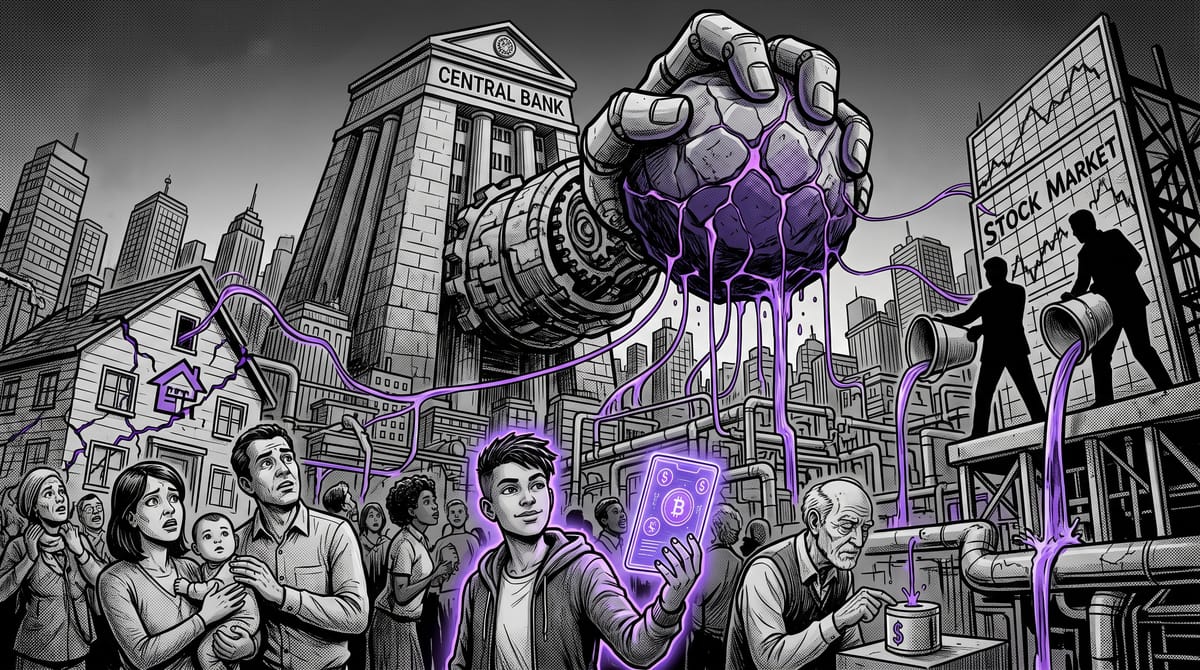
In mid September 2026, the US Federal Reserve raised its key interest rate to a range of 3.75% to 4.00%. Within days, the average 30 year fixed mortgage rate in the United States rose above 7%, far higher than the Fed's number. If a central bank sets interest rates, why are the rate on a home loan and the rate on your savings account so different from it, and who actually decides each one?
This guide follows What Is Money? The Evolution From Barter to Web3, What Is Inflation? Why Your Money Buys Less Every Year and How Do Banks Really Work? Where Your Deposit Goes. If inflation is the slow loss of money's value and banks are where money is stored and lent, the interest rate is the price that connects them. Once you understand it, headlines about rate hikes and cuts stop sounding like noise.
What Are Interest Rates in Simple Terms?
An interest rate is the price of using money, expressed as a percentage per year. Borrowers pay it to lenders for the use of their money, and savers earn it from banks for lending theirs. A higher rate makes borrowing more expensive and saving more rewarding, while a lower rate does the opposite.
Think of it as rent for money. A lender gives up the use of their money for a while, and the interest pays them for three things: waiting, the risk that the borrower does not repay, and the chance that inflation makes the money worth less by the time it comes back. That is why interest rates and inflation move together so often, and why the same rate can feel generous in a calm year and stingy in an inflationary one.
How Do Interest Rates Work?
Interest comes in two main forms. Simple interest is calculated only on the original amount, while compound interest is calculated on the original amount plus the interest already earned, so growth speeds up over time. If you put 1,000 units of money in an account for ten years, at 3% compounded yearly it grows to about 1,343.92, and at 5% to about 1,628.89. The two extra points of interest add roughly 285 units over a decade, which is why small differences in rates matter so much over long periods.
Rates also come as fixed or variable. A fixed rate stays the same for the length of the loan, while a variable rate moves with market or central bank rates, so your payment can change. Even a fixed rate does not mean a fixed bill: on a mortgage, rising property taxes or insurance can still push the monthly payment up while the rate stays locked.
The effect on a loan is bigger than most people expect. As a simple illustration, a 30 year loan of 300,000 units costs about 1,430 a month at 4% and about 2,000 a month at 7%, a gap of more than 550 every month for the same house and the same borrower. That is why a rate move of a few points makes headlines.
Who Sets Interest Rates?
The honest answer is that two different dials are at work. The first is the policy rate, which a central bank sets: in the US, the Federal Reserve sets a target range for the rate at which banks lend to each other overnight, and the European Central Bank, the Bank of England and the Bank of Japan each set their own policy rates. This rate is a lever, not the rate you pay, because banks and markets build every other rate on top of it.
The second dial is the market. In the United States, long loans such as 30 year mortgages follow the yield on ten year government bonds, known as the government bond yield, which investors set every day by buying and selling those bonds, plus a margin for the lender and the risk of the borrower. In some countries variable mortgages follow the central bank rate more directly, but the principle is the same. In late September 2026 the Fed's range was 3.75% to 4.00%, while the US ten year Treasury yield traded above 5% and the average 30 year fixed mortgage rate rose above 7%, according to Freddie Mac. That gap is the clearest example of why a central bank decision does not translate one for one into your loan.
Savings rates work the same way in the other direction. Banks decide what they pay, and they tend to pass on higher rates slowly. According to the FDIC, the national average savings rate in the US was only 0.37% in September 2026, even with the policy rate near 4%. As we saw in the guide on how banks work, that spread between what a bank pays and what it charges is how banks earn their money.
Why Do Interest Rates Change?
Central banks use rates as a brake and an accelerator. When inflation runs too hot, they raise rates so that borrowing becomes more expensive, spending slows and prices cool. When the economy is weak, they cut rates to make borrowing cheaper and encourage spending and investment. It is a tool aimed at inflation, even though higher rates feel like higher prices to anyone with a loan.
September 2026 showed this in action. The Fed raised its range by a quarter of a percentage point in a unanimous vote, its first increase since July 2023, saying the move would support a timelier return to its 2% inflation goal, according to the Federal Reserve. The European Central Bank raised its deposit rate to 2.50% on 10 September, the Bank of Japan raised its rate to 1.25% on 18 September, and the Bank of England held at 3.75% on 17 September. The common backdrop is the energy driven inflation we covered in our guide on inflation, with US inflation at 3.4% in August.
Is 4% high? By historical standards it is moderate. The Fed's rate peaked near 20% in the early 1980s, when it was fighting double digit inflation, and the most recent peak of 5.25% to 5.50% came in July 2023. At the other extreme, the ECB had negative interest rates from 2014 to 2022 and the Bank of Japan from 2016 to 2024, so banks were effectively charged for parking money at the central bank.
What Is a Real Interest Rate?
A real interest rate is the interest rate minus inflation, and it shows what your money actually earns in purchasing power. Using the middle of the Fed's range, 3.875%, and US inflation of 3.4% in August, the real policy rate is roughly 0.5%. This is only a rough calculation and not an official series, but it shows that even after a hike, safe interest barely beats rising prices.
Do Interest Rates Affect Crypto and Web3?
Often, but not mechanically. The argument for a link is simple: when safe assets such as savings accounts and government bonds pay more, holding an asset that pays nothing, like Bitcoin, becomes less attractive, and when rates fall, that reason to stay in cash weakens. Supporters of this view see rate cuts as helpful for crypto and rate hikes as a headwind.
Skeptics point out that the relationship is loose. Crypto prices respond to many other forces, including liquidity, regulation and investor appetite for risk, and some argue Bitcoin ignores central bank rates entirely. The evidence is mixed, so treat any claim that a rate decision will push crypto up or down with caution.
Web3 adds another twist: crypto platforms advertise their own interest rates for lending and staking, set by supply and demand on those platforms instead of by a central bank. They can look attractive next to a 0.37% savings rate, but they usually come without deposit insurance and with extra risks, which is why we explained the safety net of banks in our earlier guide. A higher yield is rarely free, because it normally pays for higher risk.
This article is educational and not financial advice.
The Bottom Line
An interest rate is the price of money, and it is set on two dials: the central bank controls the short one, while the market sets the long ones that decide mortgages and many loans. When inflation rises, central banks raise rates to cool prices, which helps the economy in the long run but makes life harder for borrowers in the short run. The practical lesson is to look at the rate you actually pay or earn and compare it with inflation, not just with the headline from the central bank.
Long rates are born in the bond market, where governments and companies borrow from investors. Next up: bonds, and how they turn the price of money into an investment. That is where we move from understanding money to understanding investing.
Frequently Asked Questions
- Who sets interest rates?
Central banks set a policy rate, such as the Fed's target range, which influences other rates. Commercial banks and financial markets then set the rates you actually pay or earn, including mortgage and savings rates.
- Why do central banks raise interest rates?
To slow borrowing and spending when inflation is too high. Higher rates make loans more expensive, which cools demand and helps bring prices under control.
- Does a central bank rate cut make my mortgage cheaper?
Not automatically. Long mortgages often follow bond market yields, which can move differently from the policy rate, and fixed rate loans only change when you refinance or reset.
- Why didn't my savings rate go up when the central bank raised rates?
Banks set their own savings rates and often pass increases on slowly. Comparing accounts can matter more than the central bank decision.
- Do interest rates affect crypto?
They can, because higher rates make cash and bonds more attractive compared with assets that pay no yield. But the link is loose and other factors also move crypto prices.